How to Choose the Right Copper Pipes for Your Project
Choosing Copper Pipes is not just a matter of diameter or price. The right tube must suit the water, pressure, temperature, and installation conditions. A pipe beneath a concrete slab faces different demands from a visible line in a basement. Small choices matter.
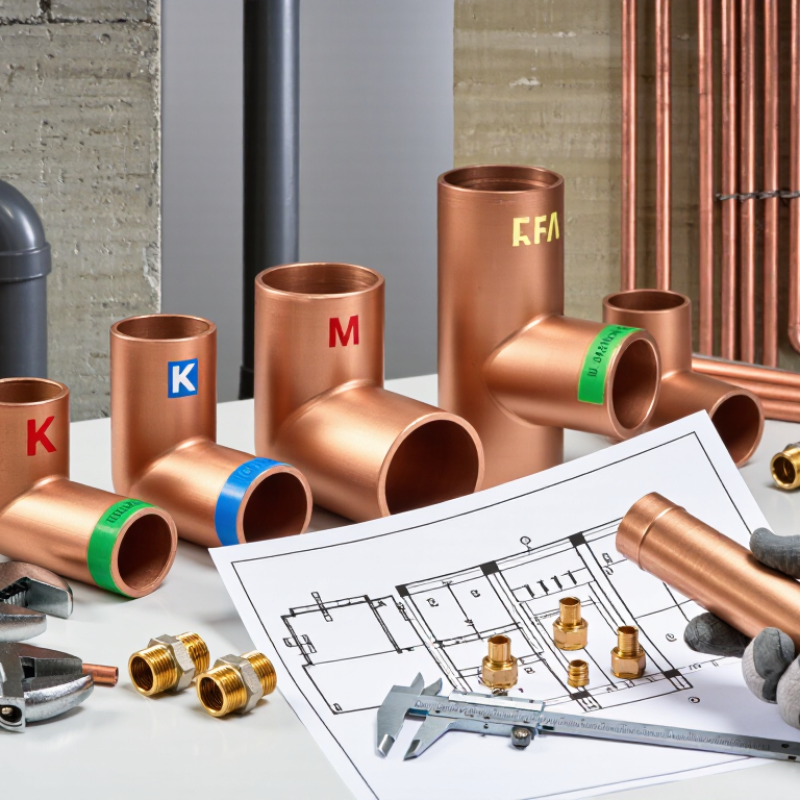
The U.S. Geological Survey’s Mineral Commodity Summaries 2024 estimated global copper mine production at about 22 million metric tons in 2023. That figure gives useful industry context, but it does not tell you which pipe belongs in your project. For sizing and tube selection, the Copper Development Association’s Copper Tube Handbook explains common ASTM B88 types: K, L, and M. Their wall thicknesses differ, so check local codes and project specifications before choosing.
Water chemistry deserves equal attention. Virginia Tech civil engineer Marc Edwards, whose research includes plumbing corrosion, has emphasized that water quality can affect how plumbing materials perform. That is a practical reminder, not a substitute for testing. Two homes can use the same tube and see different results. Before buying, compare the application, required pressure rating, fitting compatibility, installation method, and expected exposure to corrosion. Ask a qualified plumber or engineer to review uncertain conditions. Copper is durable, but no material is immune to poor design or installation. And one detail is easy to miss: the cheapest option may not be the best value.
Define the Project’s Water, Pressure, and Temperature Requirements
Before selecting copper pipe, document the water source, expected flow, operating pressure, and hottest service temperature. Small details matter. A utility water-quality report can reveal pH, chloride, and disinfectant levels, which help engineers assess corrosion risk. For hot-water lines, record the peak temperature at the fixture, not only the heater setting; recirculation can keep pipework warm for long periods.
Wall thickness affects both durability and pressure capacity. The Copper Tube Handbook’s dimensional tables, based on ASTM B88, list 1/2-inch nominal tube with a 5/8-inch outside diameter: Type K has a 0.049-inch wall, Type L 0.040 inch, and Type M 0.028 inch. These are dimensions, not universal pressure ratings. The handbook’s working-pressure tables vary with tube size, temper, and service temperature. Check the exact combination, including fittings and joining method, before specifying a line. A missed detail can undermine an otherwise sound choice. If project conditions are uncertain, verify the water data and design assumptions with a qualified plumbing engineer.
How to Choose the Right Copper Pipes for Your Project — Define the Project’s Water, Pressure, and Temperature Requirements
| Copper Tube Type |
Wall Thickness for 1/2-Inch Nominal Tube |
Typical Water-System Use |
Pressure Considerations |
Temperature Considerations |
Best Fit When… |
Type K
ASTM B88 |
0.049 in (1.245 mm) |
Potable-water distribution, underground water services, and other applications where a heavier wall is specified. |
Its thicker wall generally provides greater pressure capacity than Types L and M of the same size. Confirm the allowable working pressure for the exact tube size, temper, and joining method. |
Can be used in hot- or cold-water systems when the system design, fittings, joints, and local code permit. |
The project calls for a heavier-wall tube, including many underground or demanding service applications. |
Type L
ASTM B88 |
0.040 in (1.016 mm) |
Common choice for interior potable hot- and cold-water distribution. |
Provides a thicker wall than Type M of the same size. Check the design pressure against applicable code and product data rather than selecting by type alone. |
Suitable for hot- and cold-water service when the complete system is rated and installed for the required temperature. |
You need a general-purpose water-distribution tube with a moderate wall thickness. |
Type M
ASTM B88 |
0.028 in (0.711 mm) |
Used for some above-ground residential water-distribution installations where local codes allow it. |
Its thinner wall gives it less pressure capacity than Types K and L of the same size. Verify suitability for the system’s design pressure, including surge conditions. |
Temperature suitability depends on the tube, fittings, joints, system design, and applicable code; do not infer a temperature limit from wall type alone. |
Local code permits it and the project’s pressure, support, and installation requirements are appropriate for a thinner-wall tube. |
| DWV Copper Tube |
Wall thickness depends on nominal size and the applicable product standard; it is not selected as a pressurized water-supply tube. |
Drain, waste, and vent systems that operate primarily by gravity. |
Not intended for pressurized potable-water distribution. Do not use it as a substitute for pressure-rated water tube. |
Use only within the temperature limits and installation requirements specified for the drainage system and its joints. |
The project is a gravity drainage, waste, or vent line—not a pressurized supply line. |
Selection check: ASTM B88 Type K, L, and M dimensions vary with nominal tube size; the wall thicknesses above are specifically for 1/2-inch nominal tube (5/8-inch outside diameter). No single pressure or temperature limit applies to every copper tube: allowable ratings depend on tube size and temper, fittings, joining method, installation conditions, and local code. Confirm the design pressure, operating temperature, water chemistry, and required approvals for the complete system before specifying a tube.
Compare Copper Pipe Types, Grades, and Temper
Copper tube type describes wall thickness, not copper purity. ASTM B88 lists Types K, L, and M for water-service tubing. For 1/2-inch nominal tube, its dimensional tables specify 0.049-inch walls for Type K, 0.040 for Type L, and 0.028 for Type M. Type K offers more wall thickness; Type M is lighter. Type L often suits general plumbing, but project specifications and local requirements matter. The Copper Development Association’s Copper Tube Handbook explains these type designations and their applications. Still, the thickest option is not automatically best.
Grade describes the copper alloy. C12200, phosphorus-deoxidized copper, is commonly used for plumbing tube; the Copper Development Association’s alloy data identifies its composition. Check the product documentation rather than relying on color or a printed label.
Temper describes how the tube was processed. Drawn-hard tube usually comes in straight lengths and resists bending; annealed-soft tube is commonly supplied in coils and bends more easily around a joist. That convenience has trade-offs: tight bends can flatten the tube if poorly formed. A small detail, but a costly one.
Before buying, compare the specified type, alloy, temper, outside diameter, and fitting compatibility. ASTM B88 gives the dimensional basis, while the Copper Tube Handbook provides application guidance. For a short exposed run, straight hard tube may be practical. For a long route with several turns, soft tube may reduce joints. I would still check the installation plan twice; one missed fitting can undo a careful material choice.
Select the Pipe Diameter and Wall Thickness
Choosing copper pipe diameter starts with expected flow, not the pipe that looks substantial. A long run, several elbows, or simultaneous showers can reduce pressure at the outlet. A branch serving one sink may need less capacity than a line feeding multiple bathrooms. Measure the route, then estimate which fixtures may run together. Check a sizing chart that accounts for flow, run length, and acceptable pressure loss. Measure twice.
Nominal size does not reveal the full internal bore. Wall thickness changes the space available for water. In common copper tube classifications, Type K has thicker walls than Type L, and Type L thicker walls than Type M. Thicker walls can offer more material for demanding conditions, but they also reduce internal diameter at the same nominal size. That trade-off is easy to overlook.
Choose a wall thickness suited to the system’s pressure, temperature, installation conditions, and local requirements. Confirm the tube’s specifications rather than relying on a label alone. A chart is a useful starting point, not a perfect answer: unusual layouts and long runs may need a more careful pressure-loss check. If a distant tap already has weak flow, simply choosing thicker pipe may not solve the real problem.
Verify Code, Fitting, and Installation Compatibility
Choose copper tube by application, not by appearance. Type K, L, and M differ in wall thickness, so check pressure, water quality, and local plumbing-code requirements before ordering. The Copper Development Association’s Copper Tube Handbook reports about 1.1 inches of expansion per 100 feet of tube for a 100°F temperature rise. Leave room for movement near long runs and hot-water lines. Easy to miss.
Match fittings to the tube’s actual size, temper, and joining method. ASTM B88 covers copper water tube; ASTM B16.22 covers wrought copper and copper-alloy solder-joint fittings. Confirm the fitting’s listing and manufacturer instructions allow the planned connection, whether soldered or press-connected. Similar-looking parts are not automatically interchangeable. Codes differ by location, and adopted editions can change, so verify requirements with the local authority before installation.
Plan supports, clearances, and transitions before cutting. Copper can expand, and direct contact with some dissimilar metals may accelerate corrosion; use an approved transition where required. Keep joints accessible when the code or project design calls for it, and follow safe procedures around heat and nearby materials. A useful check is a dry fit: lay the tube and fittings along the route, then inspect alignment and access. Even a careful layout can miss one awkward joint. Easy to overlook.
How to Choose the Right Copper Pipes for Your Project
Verify code, fitting, and installation compatibility. This chart compares the standard wall thicknesses of 1/2-inch nominal Type K, L, and M copper water tube.
How to use this chart: For 1/2-inch nominal tube, the standard outside diameter is 5/8 inch. Type K has a 0.049-inch wall, Type L a 0.040-inch wall, and Type M a 0.028-inch wall. Check local plumbing codes and confirm that the selected fittings and joining method are compatible with the tube type and installation conditions.
Source: ASTM B88 standard dimensions. Millimeter values are conversions from the listed inch dimensions.
Assess Cost, Availability, and Long-Term Maintenance
Start with a project-specific quote, not a price per length alone.
Include fittings, solder or press connections, insulation, delivery, and expected labor. Copper can carry a higher upfront cost than alternatives, but prices vary by diameter, wall thickness, and local supply. The USGS Mineral Commodity Summaries 2024 reported U.S. net import reliance for copper at 37% in 2023. That national figure does not predict local shortages, but it is a reason to confirm stock and lead times before scheduling. Check locally.
Availability matters most when a project needs matching fittings or replacement sections later. Ask suppliers whether the pipe dimensions and connection type are commonly stocked, and keep spare material if repairs would be difficult. For maintenance planning, the National Association of Home Builders’ 2007 study estimated copper water pipes could last
70 to 80 years.
Treat that as an estimate, not a promise: water chemistry, installation quality, and corrosion can shorten service life. Leave accessible shutoff valves and avoid burying joints behind finishes where practical. A tidy budget can still miss future access costs; that is easy to overlook.